Merovingian Assumption textile
Type:
Textiles
Date:
Late sixth–eighth century
Location or Findspot (Modern-Day Country):
France
Dimensions:
65 × 80 cm
Description:
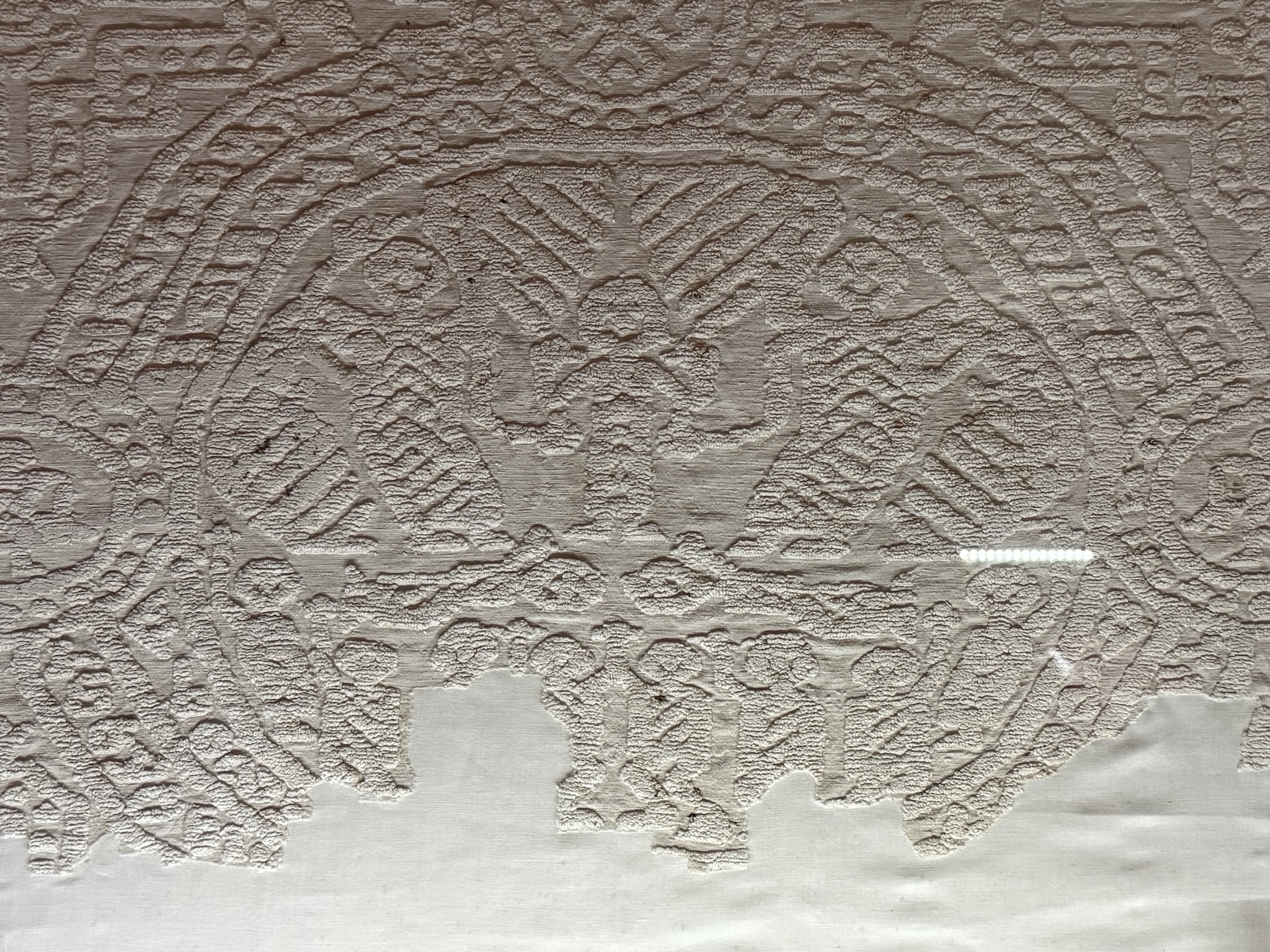
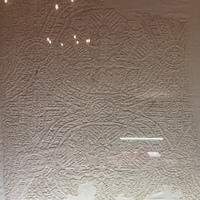
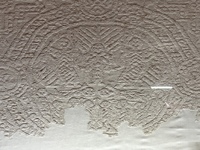
This large textile fragment depicts the Assumption of Mary, when her body and soul were taken up to heaven at the end of her earthly life. When it was woven between the late sixth and the eighth century, this iconography was established in the eastern Mediterranean and Western Asia, but it was still novel in the Merovingian realm (Gregory of Tours, in the later sixth century, was the first to write about the event in western Europe). Repeating, interlaced roundels enclose the orant Virgin flanked by angels bearing palm branches who float above eight standing apostles who witness her ascent. The pictorial models may have reached Gaul in the form of Byzantine silks.
The roundels contain inscriptions in Latin that identify the scene: "When Mary mother of God passed away from the apostles." This text was drawn from the Latin liturgy, which in turn relied on practices in the Greek-speaking cOrthodox monasteries in Rome by the seventh century.
The date of the brocaded textile—that is, a fine linen ground woven with raised patterns in wool—is derived from comparisons with textiles found in Merovingian burials, as well as by the style of the letterforms. When it was made, the complete piece was most likely a curtain hung in a church. In that public context, it would have popularized belief in Mary's assumption and implicitly underscored her proximity to Christ in heaven and her efficacy as an intercessor for pious Christians. By the ninth century, the precious textile was cut down and used to wrap relics in Sens Cathedral, where it was found in a casket of relics in 1896.
The textile is in the Musées de Sens, Trésor de la Cathédrale, inv. no. TC B 283.
Relevant Textbook Chapter(s):
3,
4
Repository and Online Resources:
• See another view of the textile on the French Ministry of Culture website.
Image Credits:
Linda Safran