Saint-Denis rock crystal
Type:
Engraved gems
Date:
ca. 842–69
Location or Findspot (Modern-Day Country):
France
Medium:
Rock crystal
Dimensions:
15.5 × 11 × 4.5 cm
Description:
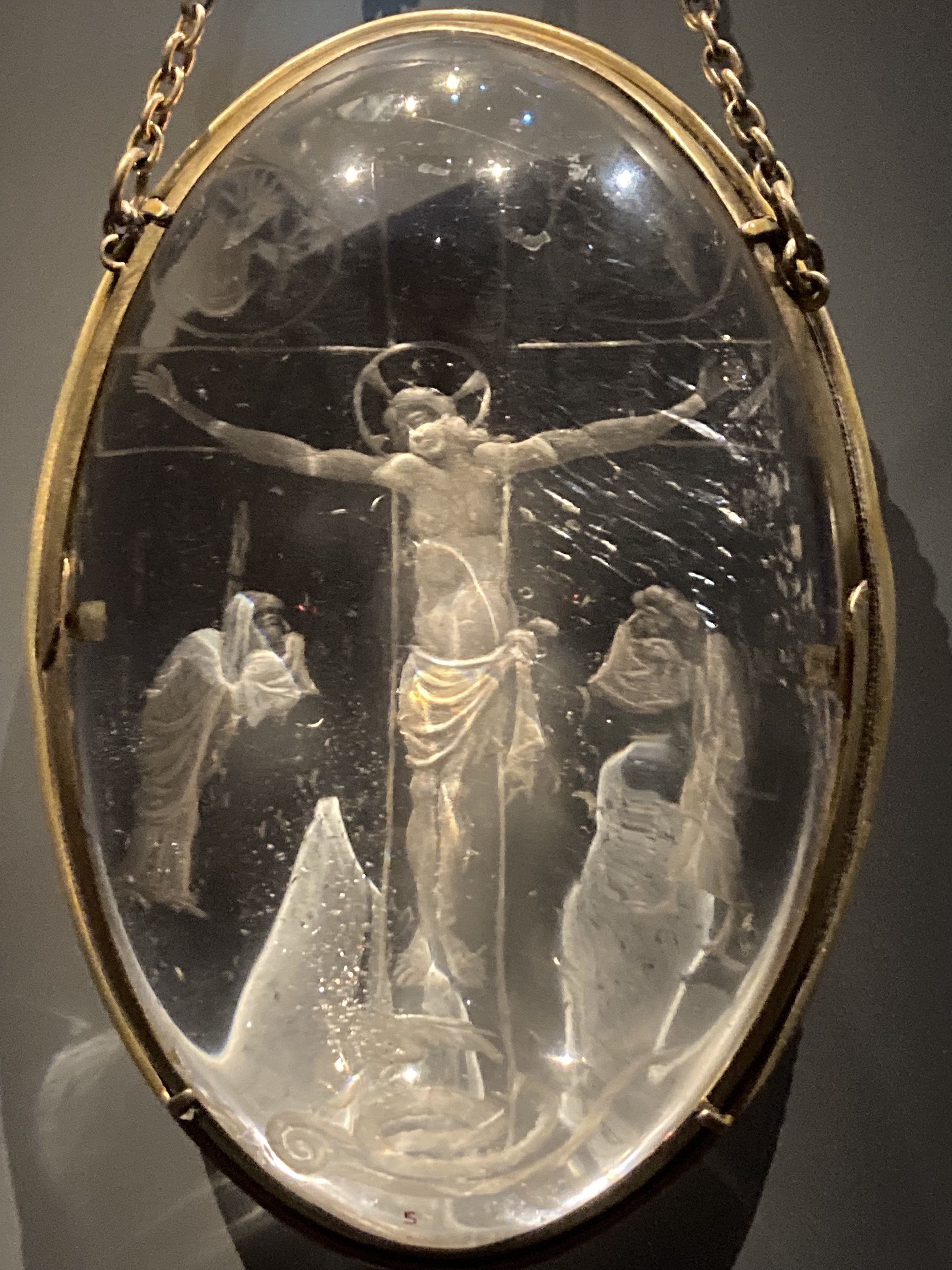
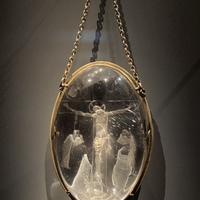
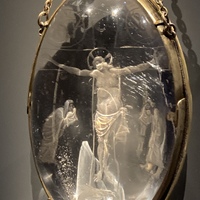
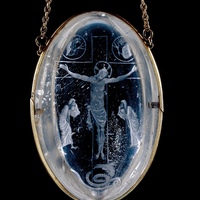
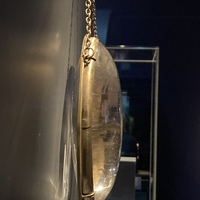
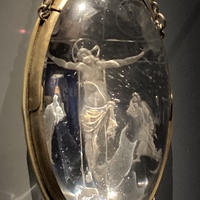
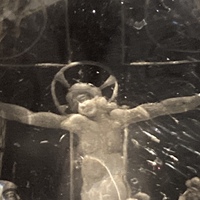
This large rock crystal depicts the Crucifixion, with Christ flanked by the grieving figures of Mary and John the Evangelist. The cross spears a coiled serpent, representing the tempter of Adam in the Garden of Eden; Christ, the New Adam, defeats sin and death. The event is witnessed by personifications of the Sun and Moon, who suggest both the event's cosmic significance and the eclipse that occurred at the moment of Christ's death.
A 7-millimeter border around the scene is visible on the flat back of the crystal, but when viewed from the front, the figures fill the convex (cabochon) oval to the edges. The crystal magnifies the intaglio images. Medieval Christians understood rock crystal as frozen water capable of emitting fire when struck by light; it was a symbol of the Incarnation and of Christ's dual nature.
The Crucifixion scene appears on eight of the seventeen surviving Carolingian rock crystals. Based on stylistic analogies with works produced in the reign of Charles the Bald, this one was probably carved in the mid-ninth century and given as a gift to the abbey of Saint-Denis, perhaps attached to a larger objet. In the twelfth century, Abbot Sugar reemployed it on a relics shrine. It reached the British Museum after the abbey's treasures were sold off during the French Revolution.
Relevant Textbook Chapter(s):
5
Repository and Online Resources:
• The rock crystal is in the British Museum, London (BM 1855,0305.1).
Image Credits:
Linda Safran; © The Trustees of the British Museum