Gunhild's cross
Type:
Crosses
Date:
First half of twelfth century
Location or Findspot (Modern-Day Country):
Denmark
Dimensions:
28.5 × 22 × 2.5 cm
Description:
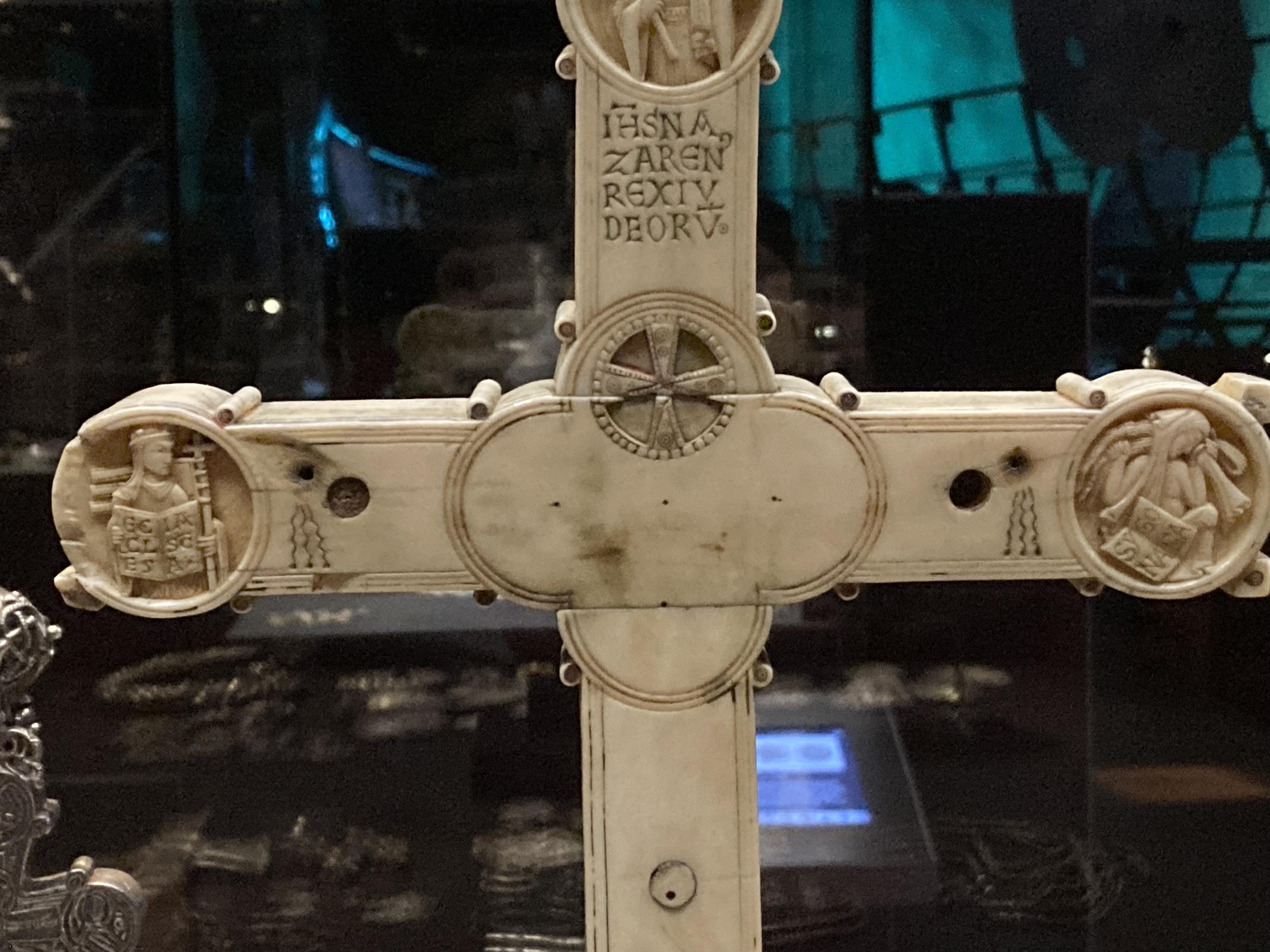
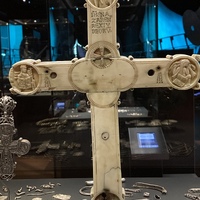
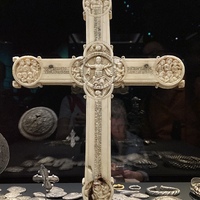
This cross, likely made in Denmark in the early twelfth century, was carved from walrus ivory imported from Greenland. The vertical shaft of the cross is visibly curved, like the tusk from which it came. The ivory likely passed through ports in Iceland or Norway before reaching Denmark. The eyes of many figures were inlaid with jet (a dark gemstone), and traces of pigments and gold suggest that the object was once more colorful and even more precious.
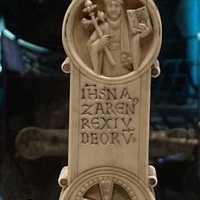
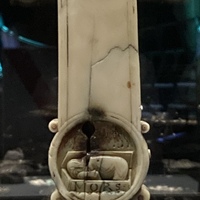
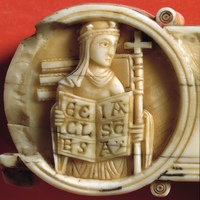
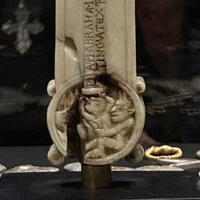
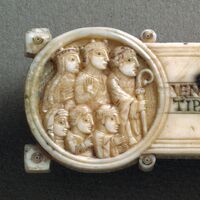
On the front of the cross, the body of Christ that once occupied the center is now missing; only the wavy lines that represent his blood remain. The roundels at the ends of the cross contain personifications of paired opposites: Life and Death (top and bottom) and Ecclesia (Church) and Synagoga (left and right). On the back, the roundels depict the bosom of Abraham, from Luke 16:22–23, and its opposite, a demon dragging a soul to Hell (top and bottom); the saved (all clothed, some with crowns and one with a bishop's crosier) and the damned (all nude) are opposed on the left and right. At the center, Christ sits in judgment.
Inscriptions on the back and sides, in both Latin and Old Norse runes, give the name of the patron four times. She was Gunhild, a daughter of King Svein II of Denmark and a descendant of King Harald Bluetooth, who in the ninth century began the slow process of Denmark's conversion to Christianity. The artist is also commemorated in a Latin inscription: "Those who trust in the crucified Christ shall in their prayers remember Liutger who carved me at the behest of Helena, who is also called Gunnhildr." Only the patron's name is written in runic letters, making it legible to more of its twelfth-century observers (ᚵᚢᚿᚼᛁᛚᛑ). The choice of Helena as Gunhild's Christian name implicitly connects her with the mother of Constantine, who allegedly found the Holy Sepulcher in the fourth century. Costly objects like this cross were often donated to a religious foundation, where the donor's name would be remembered in perpetuity.
Relevant Textbook Chapter(s):
7
Repository and Online Resources:
• Gunhild's cross is in Copenhagen, National Museum of Denmark no. 9087.
• See more photos of the cross on the Kornbluth Photography website.
• Zoom in on the cross here.
Image Credits:
Linda Safran; Lennart Larsen