Hebrew Zodiac Man
Type:
Illuminated manuscripts
Date:
ca. 1450
Location or Findspot (Modern-Day Country):
Spain
Medium:
Parchment
Dimensions:
35 × 24.5 cm
Description:
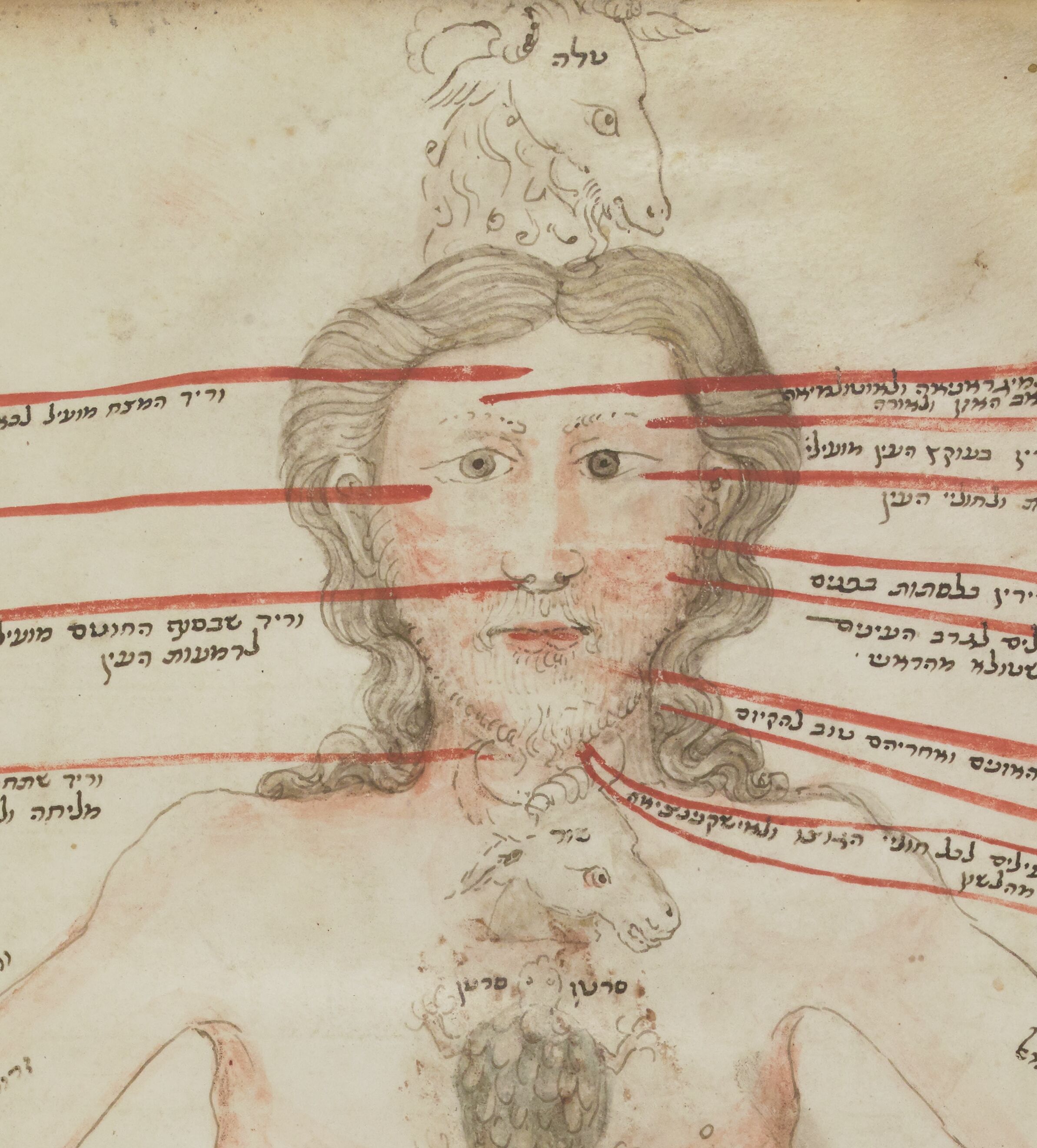
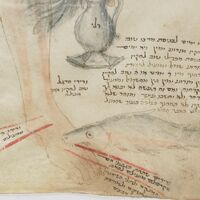
A medical miscellany copied in southern France or northern Spain around 1430 contains works by Jewish, Christian, and Muslim authors. Two decades later, someone added a full-page pen-and-ink illustration near the end of the text (fol. 264v). The nude male figure is annotated in Hebrew (Sephardic script), indicating places on the body useful for phlebotomy—that is, puncturing a vein in order to balance out the four bodily humors that were believed to control health and mood. Alongside the figure's penis is inscribed the rationale for the red lines that indicate spurting blood: "The veins on the side are used to treat pain and inflammation of the testicles, as well as diseases involving white and red discharge.” The captions are drawn from a Latin work by a fifteenth-century Catalan physician, Arnau de Villanova.
The figure also has an astrological content, because the stars and planets were thought to influence different body parts. For this reason, such a figure is often called a Zodiac Man, and he is often included in Latin and vernacular medical treatises. The twelve zodiac signs are inscribed on and around the body. The ram of Aries is at the top of the man's head because Aries heads the constellations; it is the first one crossed by the sun. Pisces fish bite his feet because this was the final constellation crossed by the sun, at the opposite end of the body.
On the facing page (fol. 265r) is a male bust with a diagrammatic cross-section of an eye, complete with captions that name the seven parts of the eye. These colored diagrams helped the owner of the book visualize and recall body parts and relevant medical procedures
Relevant Textbook Chapter(s):
10
Repository and Online Resources:
• The digitized manuscript (Paris, BnF, MS Hébreu 1181) may be viewed on the Bibliothèque nationale de France website.
Image Credits:
Bibliothèque nationale de France