Santa Maria Antiqua
Type:
Churches,
Chapels,
Wall paintings
Date:
Sixth to ninth centuries
Location or Findspot (Modern-Day Country):
Italy
Description:
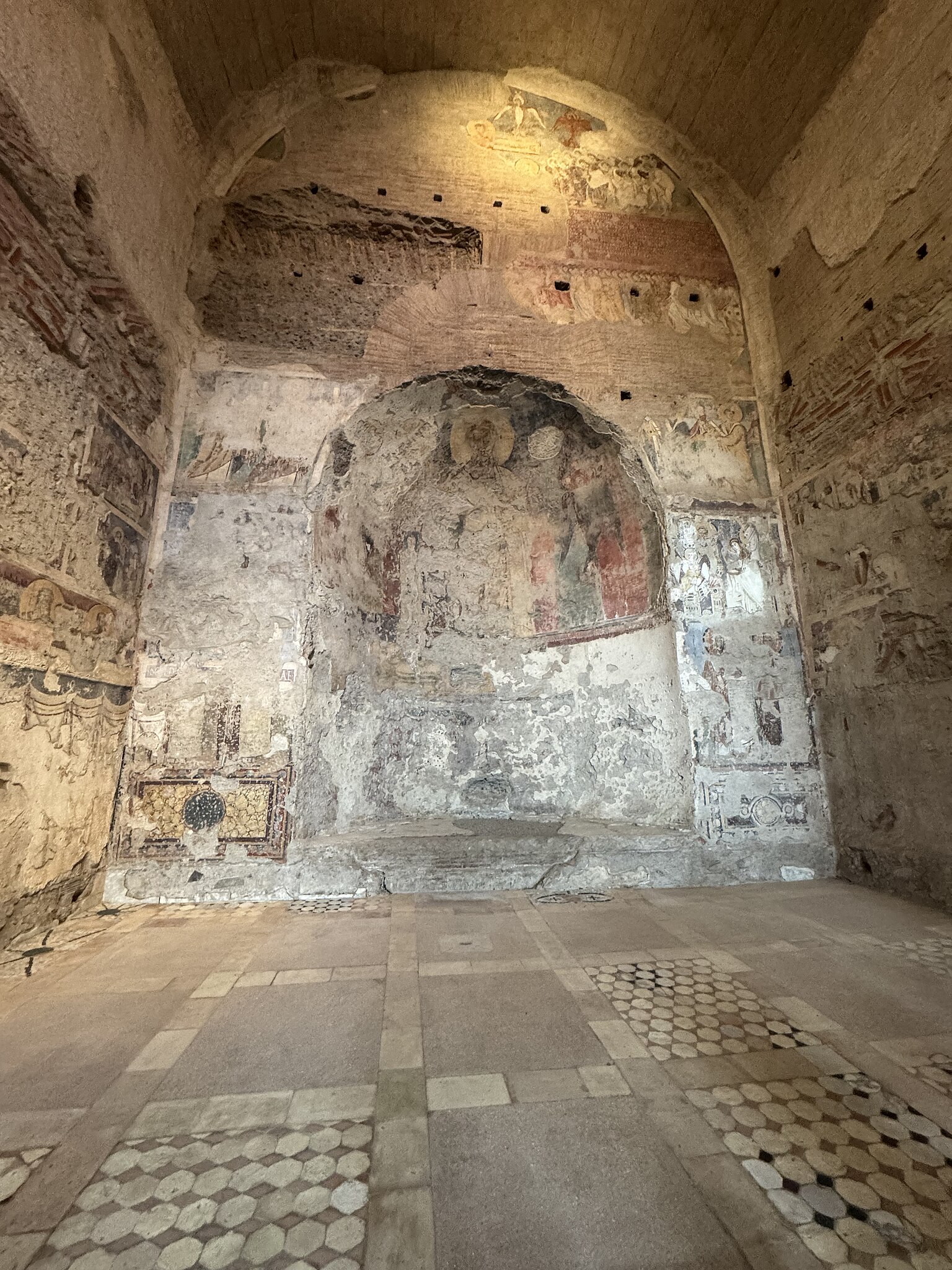
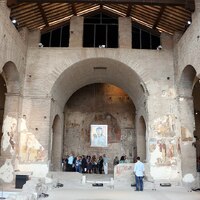
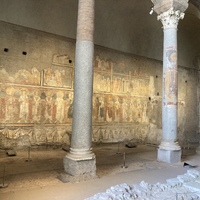
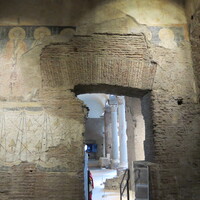
In the sixth century, a church was inserted into a first-century CE brick building in the Roman Forum, at the base of the Palatine Hill. Santa Maria Antiqua contains fresco paintings that range in date from the sixth to the ninth centuries, a period from which few murals remain in Rome. The church was damaged by an earthquake in 847 and the interior was abandoned, but some outer parts remained in use until the eleventh century, when the site became a monastery dedicated to St. Anthony. Santa Maria Antiqua is a critical touchstone for painting in both western Europe and Byzantium.
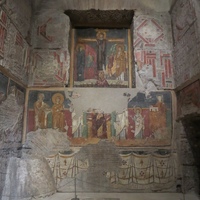
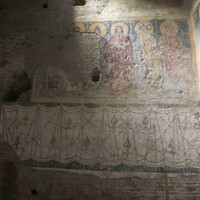
The oldest paintings are superimposed on the "palimpsest wall" to the right of the apse. These are fragments of a Maria Regina (Mary crowned and enthroned as empress of heaven) with the Christ child on her lap, being adored by an angel on the viewer's right (first half of the sixth century). The later insertion of the apse destroyed the angel on the left. At the upper right is a much more naturalistic angel, originally part of an Annunciation scene; Mary's face is visible above the nimbus of the earlier Maria Regina. The Annunciation was probably painted in the second half of the sixth century. Finally, the male head of a saint next to Maria Regina's head and the vertical inscriptions in Greek date to the papacy of John VII (r. 705–7), a Greek speaker whose father was the Byzantine official in charge of the imperial palace on the Palatine Hill.
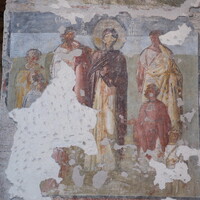
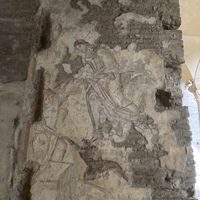
A pier on the right side of the nave, before the sanctuary, depicts a haloed Solomone with her seven sons, the Maccabees who were martyred for their Jewish faith in the second century BCE. They were venerated as precedents for Christian martyrs and considered Christian saints themselves. This very naturalistic image, with its subtle modeling of faces and drapery, was probably painted in the mid-seventh century.
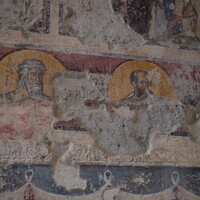
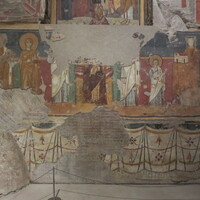
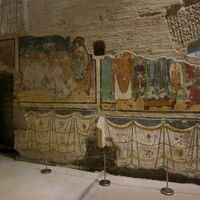
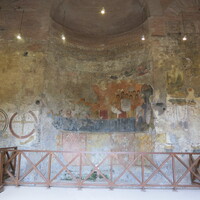
Above the apse is a large multifigure scene of the adoration of the crucified Christ, painted under John VII. This is the earliest surviving large-scale Crucifixion image, preceded only by one small panel on the wooden doors of Santa Sabina in Rome. Christ is short-haired and clad in a loincloth. A long Greek text includes Old Testament excerpts that, according to Christians, prefigured events in the Passion. In the spandrels of the apse arch are four popes, some identified by inscription; the one with a so-called square halo at the far left is thought to be John VII. The square around the head evoked the shape of a panel painting and indicated a portrait likeness. The side walls of the sanctuary were painted with fictive curtains, hung with painted hooks on painted nails. This new type of lower-wall decoration became the norm in Rome thereafter. Above the illusionistic textile are heads of the apostles, six on each side, and above them are poorly preserved Christological scenes.
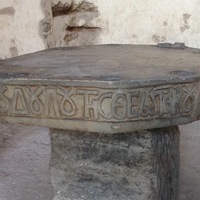
All of the paintings done under John VII use Byzantine fresco technique, in which straw is mixed with the plaster base, and it seems likely that artists from Byzantium executed these Roman frescoes. Also associated with John VII is the oldest preserved example of an image that became standard in Orthodox (not Roman-rite) churches: the Anastasis (at the end of the left aisle). The paintings on the low marble screens that delineate liturgical spaces also date to his pontificate, as does a marble pulpit base inscribed in Greek and Latin that proclaims John to be a servant of Mary, the Theotokos ("servus sancta Mariae) and "doulou tes Theotokou").
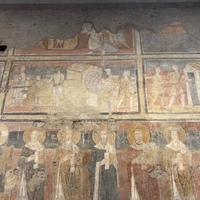
The apse itself was later repainted under Pope Paul I (r. 757–67), featuring a monumental image of Christ along with the pope's portrait. Presumably it previously displayed an image of Mary, given the dedication of the church. In the left aisle are more scenes from this campaign: Christ flanked by male saints identified in Greek and Latin, below scenes from Genesis. This was the side of the church in which men stood during the liturgy.
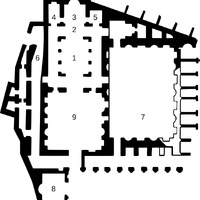
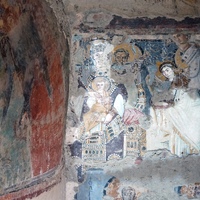
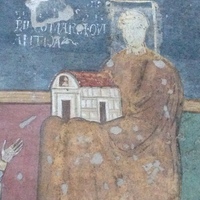
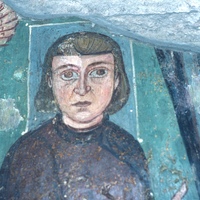
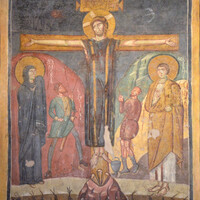
The room to the left of the apse is known as the Theodotus Chapel, after its aristocratic patron, or the chapel of SS. Quiricus (Cyr) and Julitta, to whom it was dedicated and whose story is narrated on the side walls. These paintings date between 741 and 752, the reign of Pope Zacharias, who is shown as a cleric on the south (altar) wall; opposite him, the patron, Theodotus, holds a model of the chapel as saints present him to the enthroned Virgin and Child. His "square halo" indicates a portrait, but the facial details may have been added on dried plaster, as they have worn away. Theodotus's son, or perhaps his adopted nephew—the future Pope Hadrian I—has a portrait image on the adjacent wall. Above them, the Crucifixion scene depicts Christ in a colobium, a long, sleeveless garment also seen in an eight-century Crucifixion icon now on Mount Sinai.
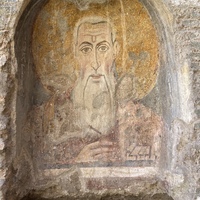
The chapel to the right of the apse is dedicated to the Holy Physicians, the anargyroi who would not accept payment (the Greek term means "without silver"), and the space may have served for incubation. Its murals were probably painted under John VII. Some physicians are shown carrying boxes that hold their equipment. The cult of one of them, Abbacyrus, was introduced in Egypt in the fifth century to counter the popularity of the goddess Isis, who had a healing shrine near Alexandria. His cult was popular in eighth-century Rome, and he is painted four times in Santa Maria Antiqua, including a well-preserved image in the atrium from the time of Pope Paul I.
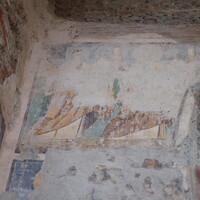
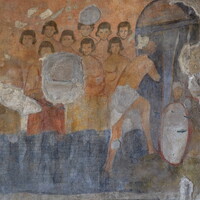
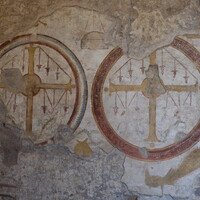
The Oratory of the Forty Martyrs depicts, in the apse, the group of men who were exposed on a frozen lake near Sebaste (Turkey) in the early fourth century because of their Christian faith. When one gave in and sought a warm bath he died, but a guard took his place among the martyrs. This fresco was probably painted under Pope Martin I (r. 649–55). The jeweled crosses to the left of the apse may be earlier.
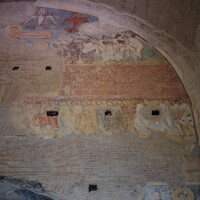
A niche in the atrium preserves fragmentary images of various date, including scenes from the life of St. Anthony likely painted in the tenth century when the outer area was reused. But it is the exceptional survival of its earlier frescoes that makes Santa Maria Antiqua a critical touchstone for painting in both western Europe and Byzantium.
Relevant Textbook Chapter(s):
3,
4,
5,
6
Repository and Online Resources:
• Listen to a 7-minute video about Santa Maria Antiqua on the Smarthistory website.
Image Credits:
Wikimedia Commons; Flickr; Adam S. Cohen; Linda Safran